Daily service requests
Open a sample dataset or import your own Excel, CSV or JSON file.

PROJECT / LCT 2026 / ROUTE PLANNING
The service assigns field service requests to engineers, sequences their visits and lets dispatchers adjust the schedule when conditions change.
An anonymized dataset for August 17, 2026, covering three service areas. These are hackathon data, not evidence of production deployment.
Two dispatcher interface screens showing a test calculation. Select an image to view it at full size.
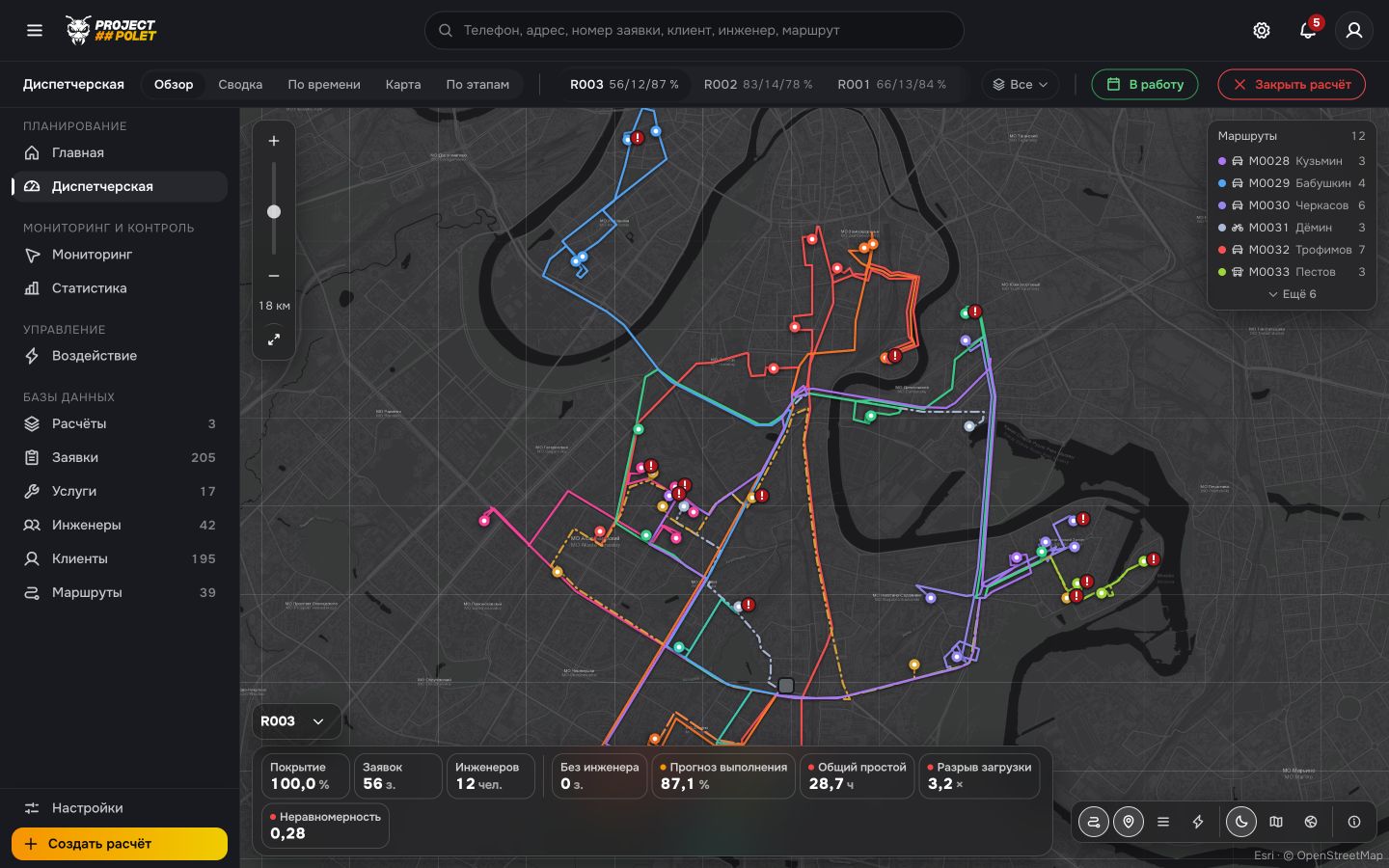
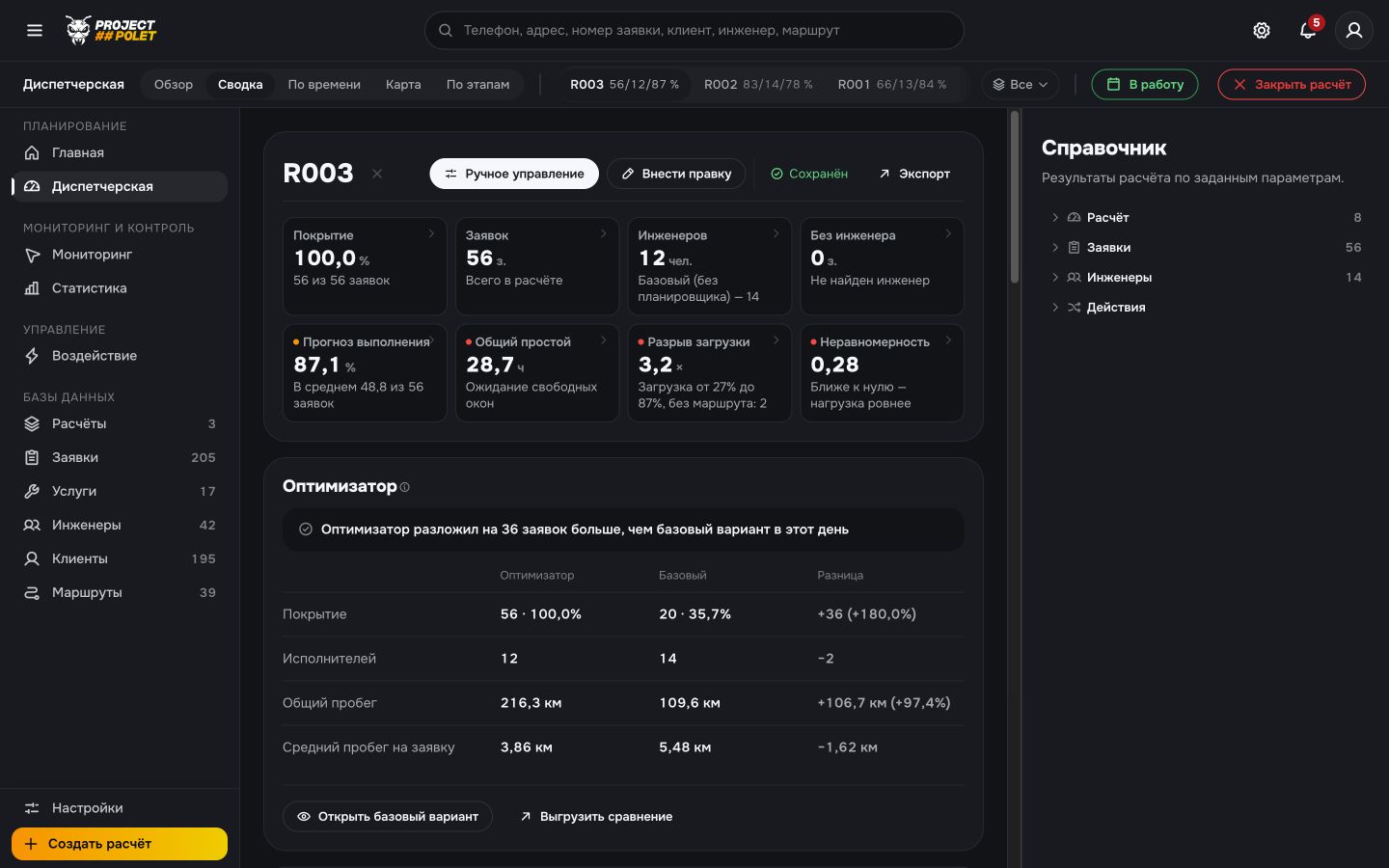
Beeline Business, the hackathon client, asked teams to plan engineer visits subject to time windows and job complexity. The plan must determine who serves each request, in what order, and which requests cannot be covered.
The optimization priorities are sequential: serve more requests, then use fewer engineers and reduce travel distance. Emergency requests receive higher priority.
The dispatcher interface shows the schedule on a map, explains decisions and shows the impact of changes during the day.
Open a sample dataset or import your own Excel, CSV or JSON file.
Assign requests to engineers while accounting for time windows, shifts, skills, vehicles and travel times.
See why a particular engineer was selected or why a request could not be assigned.
Account for an urgent incident, cancellation, engineer unavailability or delay, then compare the revised schedule with the previous one.
The table compares the baseline for three service areas with Polet. Figures are averages from eight model runs published in the project repository.
| Metric | Baseline | Polet |
|---|---|---|
| Requests assigned | 81,0 | 191,6 |
| Completed in the simulated workday | 70,7 | 169,3 |
| Engineers assigned | 42,0 | 38,8 |
| Km per assigned visit | 11,74 | 6,60 |
The comparison reflects the hackathon model and its assumptions. It does not establish the same effect on another day or in production. Total travel distance should not be compared directly because Polet assigns substantially more requests.
Before presenting a schedule, the system checks time windows, shifts, skills, vehicles, job duration and other constraints.
When an event occurs during the day, the system recalculates the remaining requests and shows what has changed.
The dispatcher can review why each request was assigned or left unassigned, along with an estimate of additional staffing needs.
The original dataset covers one day of requests in three service areas. Job durations follow an organizer-provided standard; engineer, shift, vehicle and equipment data and some other conditions are assumptions permitted by the hackathon. Absences and variation in job duration are simulated.
This was a team project. According to the repository, another team member developed the dispatcher interface. The repository does not document deployment at Beeline Business.
Full description and measurement methods on GitHubLet us discuss the available data, constraints and opportunities to automate planning.